
By Neil Patterson
(This article appeared in the Elgin and Area Heritage Society Summer 2026 Newsletter)
The 1904 Ontario Report of the Bureau of Mines states that, “the Sand Lake Mica Mine was the largest mica mine in the region”; a formidable claim indeed! Located in South Crosby Township, Concession 7, Lot 14, about 4 miles southwest of Elgin just off the Davis Lock Road, the Sand Lake Mica Mine began as a phosphate mine around 1870 when Edward Schultze mined 15 tons of phosphate for export to Germany. In 1900, the mine was acquired by the Brockville Mining Company. (Previously, it had been known as the McLaren and Fulford Mine and sometimes as the Hardy Mine).
From 1905 to 1907, it was mined extensively by the Brockville Mining Company, employing up to 20 miners. In 1912, the mining rights were purchased by Mendels and Smith of Perth. In 1900, the mining complex had a structure that housed a 20-horsepower steam engine used in hoisting and drilling and in powering a pump to keep the working area dry as the mine was 75 feet below ground level. There was a culling shed, a boarding house, and a cook house; 3 years later a tramway was built. The tramway carried the barrels of mica from the mine to a large loading dock on Sand Lake.
From there the barrels of mica were transported via the Rideau Canal to Perth, and later to Kent Brothers in Kingston for cobbing (ie. slicing the rocks of mica into thin see-through sheets). Mica does not conduct electricity and can withstand very high temperatures; qualities that allowed it to be used as insulators inside light bulbs and radio tubes; as windows in stoves, lanterns, buggies and some cars; additionally, it was ground up for lubricants used in paint and glaze for floor and wall tiles.
The production volume of the mine was inconsistent between 1900 and 1912. The mine’s highest income year came in 1903 when it produced $23,000 worth of mica, about 20% of Ontario’s total production that year of $103,205. The 1901 Census names 12 miners and mine manager, Duncan Page, as living in the boarding house. Also noted in 1903 by the Ontario Bureau of Mining, the Brockville Mining Company installed a 40-horsepower steam engine.
In 1902, Smith and Lacy of Perth, encouraged by the rich production, bought the mining rights for the adjacent lot 13 and blew several test pits. Two years later they sold those rights to the Loughborough Mining Company who never found any extension of the lot 14 mica vein. Unfortunately, the Sand Lake Mine did not run horizontally, but was what was called a chimney vein that ran vertically. During this period, John Sullivan, manager of the Brockville Mining Company, moved to Elgin, taking up residence in a 2-story brick house just past the Dunn House on the Davis Lock Road. Two of the principles of the Brockville Mining Company, McLaren and Fulford, previously the mineral rights owners of the phosphate mine, sold their product for fertilizer to England and Germany.
The 1907 Ontario Mining Report supplies these details:… the mica extracted from the mine is of a very dark amber ….the superintendent is Mr. H. Stanger …. there are 15 miners employed. The size of the mine is 85 feet in depth and 40 feet in width with a 40 horse-power boiler for the drills, pumps and the donkey.”
In 1912, the mine, newly purchased by Mendels and Smith of Perth, reportedly marketed 12 tons of mica valued at $20,570. That was the last year of mining on the property. However, in 1916, John Sullivan and Jack Fahey of Elgin bought the mine and began to extract a mica/stone mixture from its slag heaps. This detritus was transported by wagon to a newly-erected, so-called “cobbing” building in Elgin (where today stands a small engine repair business).
The actual processing done there consisted of separating the mica from the stone. Freshly cleaned, the retrieved mica was bagged, taken to the newly established Elgin Railway Station and shipped to two different paint companies who had contracted with Sullivan and Fahey to supply them with the product.
Today, near the mine entrance, can be seen four long black bolts sticking out of the ground. Ray Murray, a nearby resident, said that these rods secured the pulleys, cables and steam powered donkey used to transport the barrels of mica to the dock. Time has partially uncovered the remains of the pipe that exhausted the water from the mine. With the development of J.W. Lane and the accompanying residences, the site of the mine has almost totally disappeared. The remains of the boarding house, the steam engine building, the tramway and the cribs, and dock at Sand Lake have vanished.
When the mine closed, Philip Murphy obtained a wooden bagging machine that had been used to bag mica. Ray Murray said it was used to bag mica to take to the dock by wagon. Whether it was used before the tramway or after is not known. Later on, farmers used this equipment to bag grain to take to the mill at Forfar.
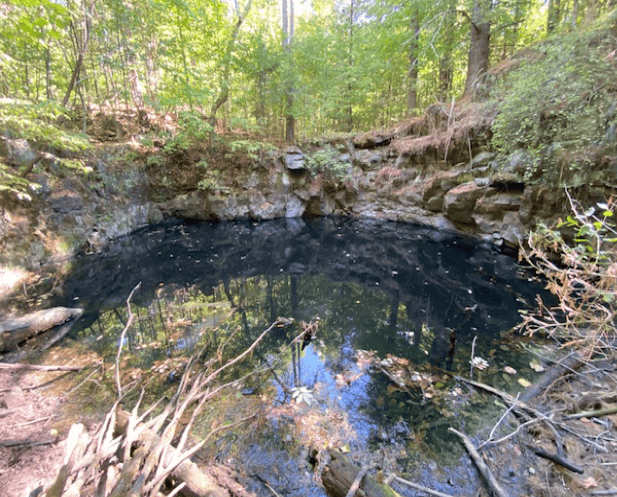
All that is left as evidence of where the mine existed is a large hole filled with water.
Article submitted by Neil A. Patterson. Photo of Sand Lake Mica Mine as it appears today courtesy of Bill Murray.